
Soilless cultivation is a modern agricultural production method in which plants are grown by supplying water and essential nutrients directly to the root zone through specially formulated nutrient solutions, rather than using soil. Today, it is widely adopted in commercial greenhouse production to achieve higher yields, superior crop quality, and sustainable agricultural practices.
Soilless cultivation consists of two main systems: Hydroponic Culture and Substrate Culture (Growing Media Culture). Among these, substrate culture is the most widely used method in commercial greenhouse production worldwide.
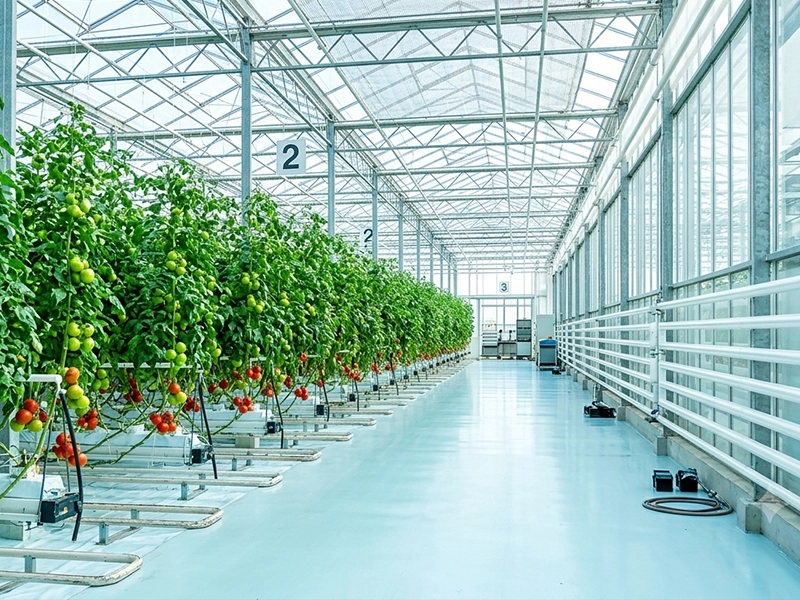
In this production system, plants grow in media such as cocopeat, rockwool, or perlite instead of soil. Water and essential nutrients are delivered precisely to the root zone through computer-controlled irrigation and fertigation systems.
By receiving balanced amounts of nitrogen, phosphorus, potassium, calcium, and essential micronutrients, plants develop more efficiently, produce higher-quality crops, and achieve greater productivity throughout the growing season.
As global population growth, decreasing arable land, efficient water management, and soil-borne diseases become increasingly important challenges, soilless cultivation has become one of the preferred production systems in modern greenhouse agriculture.
In hydroponic systems, plant roots are in direct contact with the nutrient solution. Since water and nutrient delivery are precisely controlled, the system offers outstanding production efficiency and crop performance.
In substrate culture, plants are grown in media such as cocopeat, rockwool, or perlite. It is the most widely used cultivation system in commercial greenhouse production due to its reliability and high productivity.


Copyright © 2025 Sima Seracılık Tarım Ürünleri Ticaret ve Sanayi Limited Şirketi, All Rights Reserved.